
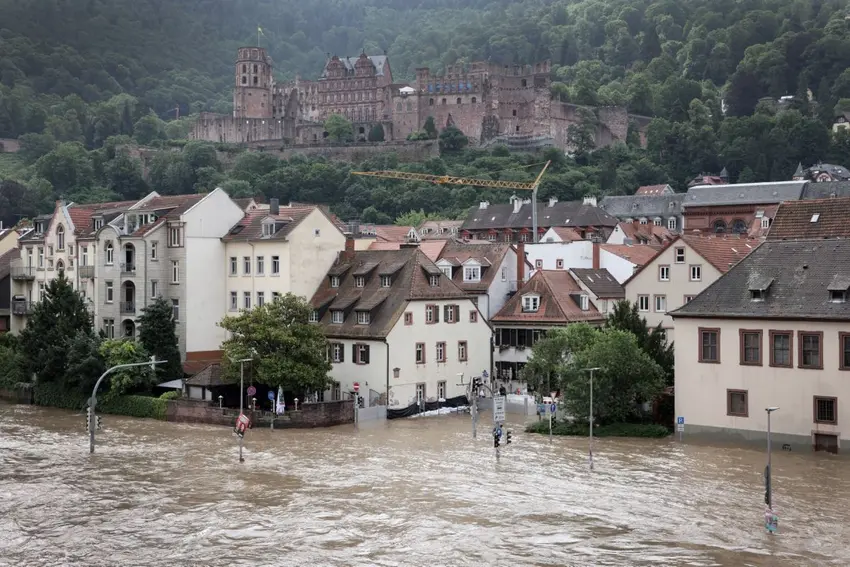
The displacement of people from their homes, due to both conflict and natural disasters, is usually thought of as a problem that exists outside of Germany.
But tens of thousands of people have been displaced from their homes due to natural disasters in Germany in the past decade.
Extreme weather events – including storms, floods, droughts and even wildfires – are becoming more common and more intense due to climate change, and displacements can also be expected to increase in number.
So how many people have already been displaced by natural disasters in Germany, and which regions have been particularly affected?
How many people have been displaced by extreme weather events in Germany?
The Internal Displacement Monitoring Centre (IDMC) collects data on the displacement of people in countries around the world. The IDMC defines internal displacements as the "forced movement of persons within the borders of their country".
So if your house washed away, or was otherwise made uninhabitable by severe flooding, and you had to at least temporarily stay somewhere else in Germany, you would be considered “internally displaced”.
The IDMC has monitored displacements in Germany due to natural disasters since 2008. According to the IDMC's data, there have been approximately 84,000 internal displacements in Germany due to natural disasters from 2008 to 2024.
Of these, around 78,000 were the results of floods, around 4,100 were the result of storms, and around 1,900 were the result of fires. These were attributable to at least 27 disaster events.
At the request of The Local, the IDMC shared data on the displacements that had been recorded between 2017 and 2024.
When the locations of the displacements shared by the IDMC are mapped it looks like this:
The above map does not include displacements recorded before May 2016 or after the end of May 2024.
According to information shared on the IDMC's website, around 7,000 displacements due to natural disasters were recorded in Germany in 2024 alone - most of which were attributed to floods that occurred between February and June.
The biggest displacement event was caused by flooding in Bavaria and Baden-Württemberg in June.
The IDMC says it has "medium confidence" in its figure of displacements in Germany for last year, noting that the total number is "considered an underestimate due to a lack of systematic monitoring and reporting of disaster displacements in the country".
The IDMC data is based "on regional and local authorities as well as data published by the media, provided they cited reliable sources or that their information could be corroborated".
Ahr Valley floods
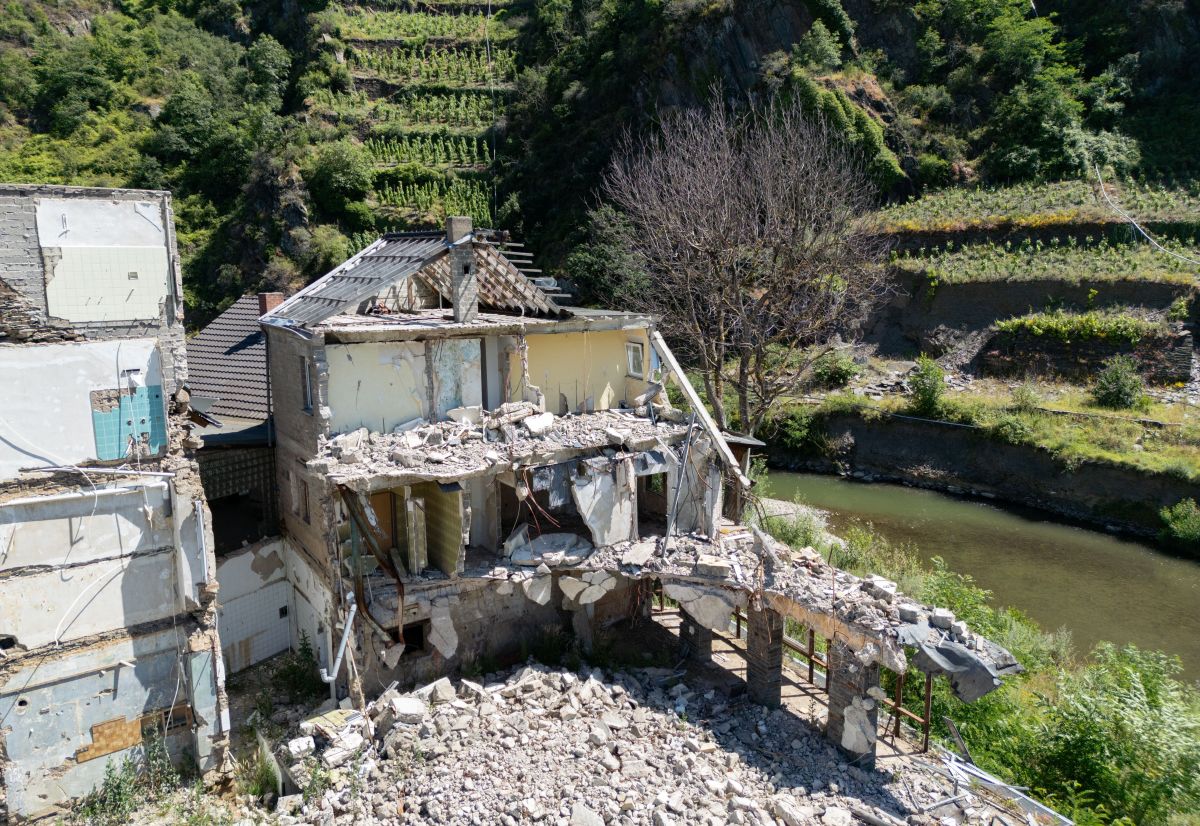
The biggest displacement event in Germany in the past decade was the flooding that occurred in and around the Ahr Valley in July 2021, which killed over 150 people, damaged thousands of homes and buildings, and changed the lives of people living in the region.

Martin von Langenthal was directly involved with the response to the Ahr Valley floods as the Deputy Head of the EU-Civil Protection and Resource Management Unit for the Red Cross.
“We know that around 40,000 people were affected overall, and around 3,500 people were living in homes that had to be rebuilt because they were so damaged,” Langenthal told The Local.
In events like these it’s not only the flood waters themselves that affect people. For those who manage to avoid the worst of the physical impacts of a disaster, it’s the lack of resources and functioning infrastructure in the following days, weeks and even months that can pose serious risks.
“Over 70 bridges were damaged, wastewater treatment facilities were damaged, the internet connection was bad and your doctor was gone,“ Langenthal said.
“All the medical records and your prescription drugs were gone as well. So was your nursing care team,“ he added. “What we need to do better…is to make these things more resilient.”
Where in Germany is particularly affected?
As The Local previously reported, a study by the German Insurance Association (GDV) last year found that 300,000 addresses in Germany are at risk of flooding.
The GDV study cites Saxony as the state with the highest proportion of at-risk homes, followed by Thuringia and Rhineland-Palatinate.
At the district level the district of Cochem-Zell in Rhineland-Palatinate is the most threatened, followed by Gera in Thuringia and Koblenz in Rhineland-Palatinate.
READ ALSO: Where in Germany do homeowners face the greatest flood risk?
Asked which regions he thought were acutely threatened by natural disaster risks, Langenthal said that beyond the known flood risks - across much of west and southwest Germany - he was concerned about drought impacts in the future.
"If you look at the east of Germany, especially in Brandenburg, they are seeing increased possibilities of wildfires... also in the Harz mountains area, the whole area looks very different because so much of the forest has been burning there," he said.
In July villages in Saxony and Brandenburg were evacuated due to wildfires that burned at least 1,000 hectares.
More disasters in a warming world
According to a report by Süddeusche Zeitung (SZ), the 2021 floods caused €33 billion in damage in Germany with €15 billion being spent on reconstruction in the Ahr Valley alone.
The costs involved with these kinds of disasters – as well as death tolls and the displacement of people and communities – can only be expected to rise in future years as climate change makes natural disasters both more intense and more common.
"What we are seeing is due to climate change these events will happen more often and will become more severe,” Langenthal told The Local.
A team of researchers at Karlsruhe Institute of Technology (KIT) ran simulations to understand what a similar event would look like in a world that has warmed by 2C. (As of 2021, global surface temperatures were between 1.1C and 1.2C warmer than temperatures in the late 19th century according to NASA and Copernicus records.)
The KIT study found that at 2C of warming, a similar event could be expected to bring 18 percent more precipitation, and due to the steep shape of the Ahr Valley, this would correspond to flood waters reaching 39 percent higher.
READ ALSO: Climate change could double summer rainfall in the German Alps
Impact on home insurance
It’s not only scientists, aid workers and people living in immediately affected areas who have warned about climate impacts in Germany.
In March, a board member for the insurance group Allianz made a startling post on LinkedIn, in which he explained that at 3C of warming “capitalism as we know it ceases to be viable”.
As the largest insurance company in the world, Germany-based Allianz is uniquely exposed to climate threats. In 2023, Allianz spent a total of €987 million on losses caused by natural hazards in Germany alone.
In at least ten US states, including California and Florida, home insurance markets are already nearing the breaking point due to climate-linked natural disasters.
For now, homes across the vast majority of Germany can still be insured against flooding. An Allianz spokesperson previously told The Local that it was possible in many cases, even in places considered class 4 flood zones.
In the Ahr Valley, rules around insurance policies and aid money pay-outs may actually be increasing future risks. SZ’s reporting shows that many existing homes remain in known flood risk zones, while others are being rebuilt nearby.
In many cases, displaced people who want to rebuild have little to no choice.
Langenthal explained why many people don't move further uphill: “The hard situation for the people there is they get money rebuilding a home, for damages that have occurred, but they do not get any money for moving somewhere else.”
This reporting was supported by the Arena Journalism Climate Network.
Comments